
Fujairah Heritage Village: An Authentic Journey to the Heart of the Emirati Soul
The morning sun caresses the ochre walls of a traditional mud-brick house. Inside, a skilled craftswoman weaves palm fibres using techniques that date back thousands of years, while in the distance the call of the muezzin echoes. No, you haven’t travelled back in time. You are in Fujairah Heritage Village, one of the best-preserved cultural treasures in the United Arab Emirates, where Bedouin history comes to life before your eyes.
In a country renowned for its futuristic skyscrapers and oversized shopping malls, this open-air museum offers a striking contrast: a window in time to the authenticity of a bygone era. Far from the glitz of Dubai, Fujairah Heritage Village invites you to immerse yourself in the daily life of the Emiratis of yesteryear, when survival depended on ingenuity in the face of an arid and unforgiving environment.
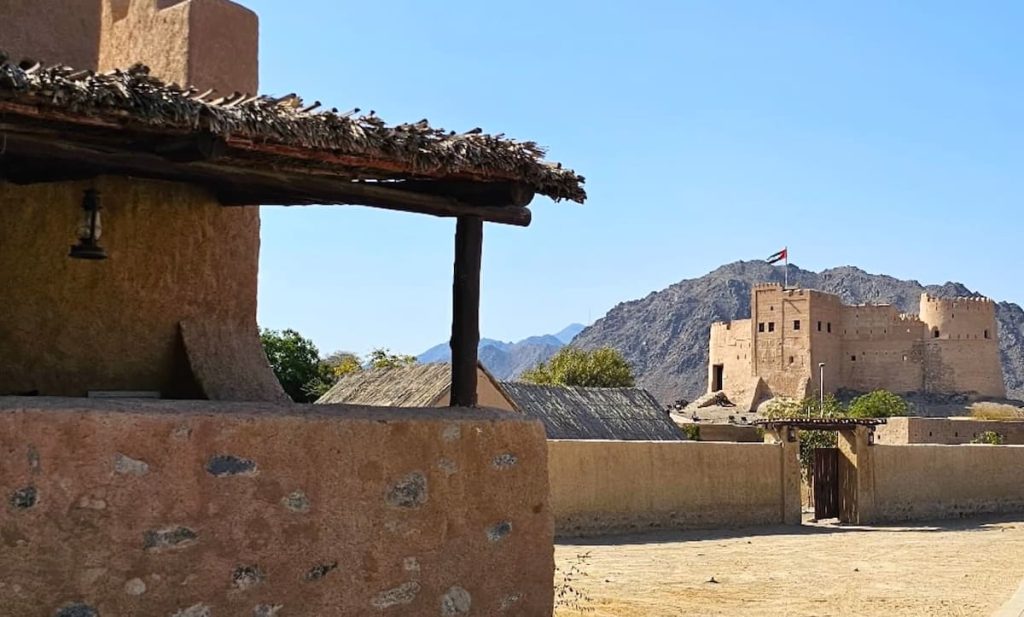
Whether you are a history buff, a photographer in search of authenticity or a traveller eager to understand the soul of the UAE beyond appearances, this exceptional site is well worth a visit during your getaway to the country’s easternmost emirate.
What is Fujairah Heritage Village?
Nestled in the Madabb district, a few kilometres from Fujairah city centre, Heritage Village is much more than just a museum. This is one of the places to visit during your stay in Fujairah. It is a meticulous and lively reconstruction of a traditional Emirati village, established in 1996 with a clear mission: to preserve the cultural heritage of a region undergoing rapid transformation.
Surrounded by an imposing defensive wall punctuated with watchtowers – a faithful reproduction of the fortifications that once protected coastal and mountain communities – the village covers several hectares. As soon as you step through the entrance, you leave the 21st century behind and immerse yourself in a world where every detail tells a story.
The “arish” houses, built using traditional techniques with dried mud and woven palm leaves, stand in rows like architectural testimonies to remarkable adaptive genius. These dwellings, perfectly designed to withstand the scorching summer heat, reveal the intelligence of the Emirati builders who, without modern technology, were able to create surprisingly functional living spaces.
Unlike conventional museums where artefacts lie dormant behind glass cases, here everything breathes and lives. Artisans perpetuate ancestral techniques, agricultural tools bear witness to an intimate relationship with the land, and the atmosphere itself seems imbued with echoes of a still vibrant past.
The Village’s Hidden Treasures: What to See and Do
Traditional Architecture: The ‘Arish Houses
The traditional dwellings are the heart of the village and its main attraction. These mudbrick and woven palm leaf structures are a testament to Emirati vernacular architectural genius.
Step inside these dwellings and you will discover an ingenious layout: cramped but surprisingly cool rooms, strategically placed openings to create natural air currents, and wall niches used for storage. The furnishings are limited to the essentials – woven rugs, a few cushions, copper kitchen utensils – reflecting a nomadic lifestyle where simplicity was synonymous with freedom.
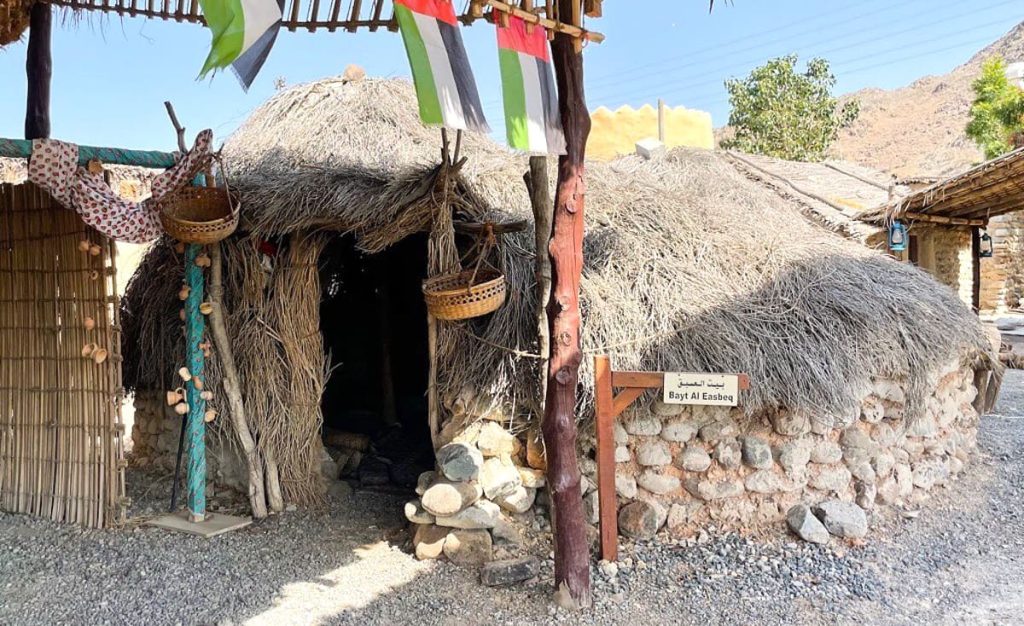
Local guides, often from Emirati families in the region themselves, passionately share anecdotes from their ancestors: how families gathered around the fire to bake bread, how women managed the household with remarkable efficiency, how each member of the community contributed to the collective survival.
Craft Demonstrations: The Living Art of the Ancients
What truly sets Fujairah Heritage Village apart from conventional museums are its live craft demonstrations. Artisans, mainly elderly women who are the guardians of ancestral knowledge, regularly set up shop in the village’s various stalls to perpetuate their arts.
Watch a weaver transform palm fibres into sturdy baskets, a technique passed down from mother to daughter for generations. The patience and precision required are awe-inspiring: every movement is measured, every fibre placed with intention. These baskets were once used to transport dates, fish and precious goods across the desert.
Pottery is another captivating spectacle. Without electric wheels, using techniques that date back thousands of years, potters shape local clay to create jars, plates and containers. The process of drying in the sun and then firing in traditional kilns reveals a perfect mastery of the natural elements.
Don’t miss the occasional cooking demonstrations where traditional dishes such as harees (a wheat and meat dish) or luqaimat (sweet doughnuts) are prepared. The aromas of cardamom and saffron wafting through the air instantly transport you to the feasts of yesteryear.
Irrigation and Agriculture: The Falaj System
In a region where every drop of water is precious, the Emiratis have developed remarkably ingenious irrigation systems. The village features a faithful reconstruction of the falaj, a network of underground and surface canals that carry water from mountain springs to arable land.
This system, listed as a UNESCO World Heritage Site in other similar regions of the Middle East, demonstrates a sophisticated understanding of hydraulics. Explanatory panels detail how it works, while sections of the network remain visible and sometimes even functional.
The Al Yazrah exhibition is also worth a visit: it presents ancient methods of ploughing using oxen or camels. Hand tools – hoes, sickles, measuring instruments – dot the reconstructed agricultural space, reminding us of the hard work involved but also of the extraordinary ability of communities to cultivate the impossible in extreme conditions.
Traditional Boats: Maritime Heritage
Fujairah has always had a close relationship with the sea, and the village places great importance on maritime traditions. Shasha boats, made from skilfully woven and waterproofed palm leaves, are masterpieces of naval craftsmanship.
These light boats allowed fishermen to sail close to the coast to catch fish and shellfish. Their design shows how well they’re suited to local conditions: sturdy enough to handle the waves of the Gulf of Oman, yet light enough to be carried by one or two men.
Models and full-scale replicas also illustrate the evolution of naval technology, from these modest boats to the dhows that once plied the trade routes between Arabia, Africa and India, carrying spices, pearls and precious fabrics.
How to get to Fujairah Heritage Village?
Located in the Madabb district, Fujairah Heritage Village is approximately 2 kilometres from Fujairah city centre, in an area easily accessible by road.
From Fujairah Airport: Just 15 minutes by taxi or private car.
Free, spacious parking is available on site, which is particularly useful during busy periods.
Opening hours and admission fees: One of the major advantages of Fujairah Heritage Village is its admission policy: entry is completely free. This desire to democratise access to culture is in line with the Emirati philosophy of sharing heritage.
Opening hours: The site is generally open to visitors from Saturday to Thursday from 8:30 a.m. to 6:30 p.m., and on Fridays from 2 p.m. to 6:30 p.m. (after Friday prayers). These hours may vary slightly depending on the season, so it is advisable to check before your visit.